
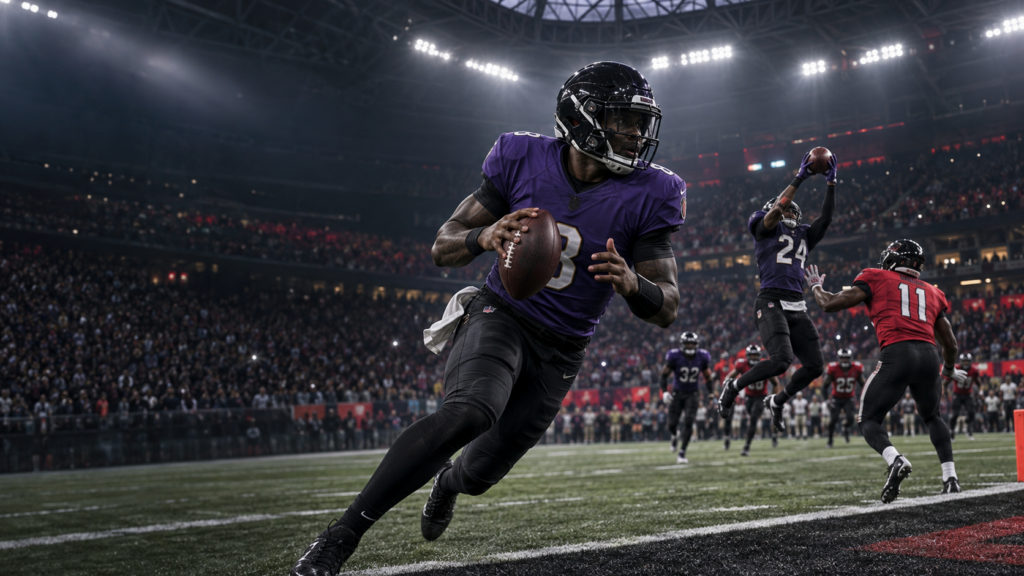
Baltimore needed a touchdown, a two-point conversion, and another scoring drive to escape Atlanta. Baltimore delivered all three behind Tyler Huntley, and Kyle Hamilton finished the job with an interception as the Ravens beat the Falcons 30–23 in overtime on October 11, 2026, at Mercedes-Benz Stadium. Atlanta’s game breakdown confirms the Week 5 result.
Atlanta’s October 12 injury update said further imaging for Michael Penix Jr. was planned for Monday. His optimism about returning the following week remained his own assessment.
The Ravens vs Falcons matchup turned on execution at the end of regulation and on both overtime possessions. Baltimore improved to 4–1, while Atlanta fell to 2–3. Huntley started with Lamar Jackson sidelined by an ankle injury, according to Baltimore’s reports.
The Eight-Point Deficit Required Two Answers
Atlanta held an eight-point advantage with 2:31 remaining in regulation. Baltimore’s previous two possessions had ended in three-and-outs, but Huntley then directed a six-play touchdown drive, according to the Ravens’ account of his finish.
A holding penalty left Baltimore facing first-and-20. Huntley escaped pressure and targeted Zay Flowers, drawing a defensive pass interference penalty that helped restart the possession. He ultimately found Devontez Walker for a 7-yard touchdown against tight coverage.
The touchdown alone could not erase the deficit. Derrick Henry took a direct snap and reached the end zone for the two-point conversion, bringing Baltimore level at 23–23. That sequence explains the comeback’s central demand: the Ravens had to complete the drive and then execute another scoring play with the game still at stake.
Huntley completed 11 consecutive passes across Baltimore’s final two drives. His finish gave the offense continuity precisely when another stalled possession would have left Atlanta in control.
Hamilton Made The Overtime Lead Final
Baltimore won the overtime coin toss and chose to receive. Huntley led a 14-play touchdown possession and scored on a quarterback sneak. The offense had created a lead, but Atlanta still had its own possession to answer.
That opportunity went to Tua Tagovailoa, replacing injured starter Penix. Near midfield, Tagovailoa targeted Drake London, and Hamilton intercepted the pass to end the game. Baltimore’s Hamilton report describes the decisive turnover.
The finish joined two different kinds of execution: a sustained offensive possession and a defensive takeaway. Huntley established the lead; Hamilton made it final.
Atlanta Had Built Its Lead In Different Ways
To understand the opportunity Atlanta lost, look back at how the Falcons had built their advantage.
Jessie Bates III supplied Atlanta’s opening touchdown by returning a fumble 36 yards. Later, he broke up a two-point pass intended for Mark Andrews, preserving a 17–15 Falcons lead in the third quarter. Atlanta’s game breakdown details both interventions.
Penix also helped Atlanta recover from its slow offensive start. A 25-yard completion to London on third down opened a productive stretch that included a 36-yard pass to Jahan Dotson and a touchdown pass to Kyle Pitts.
Those plays help explain why Atlanta remained ahead despite Baltimore’s ability to move the ball. A defensive score supplied an early advantage, and downfield completions turned difficult situations into offensive opportunities. The late collapse should not obscure the plays that had put the Falcons in position to win.
Supporting Performances And Third-Down Problems Explain The Result
Baltimore finished with 208 rushing yards, including Henry’s 102 yards on 24 carries. Justice Hill added a 47-yard run after lining up at fullback, a design highlighted in the Ravens’ same-game analysis.
The rushing production gives Huntley’s late passing a broader context. Henry’s workload and Hill’s explosive run offered different ways to create offense.
Baltimore’s recap lists Huntley at 24 completions on 32 attempts for 201 yards and three total touchdowns. Those totals give the late touchdown drive a broader context without making it the whole story of Baltimore’s offense.
Kicker Tyler Loop also kept Baltimore within reach, making all three field-goal attempts, including two from 51 yards. Those points mattered in a game that required a touchdown and conversion just to reach overtime.
Atlanta, meanwhile, converted nine of 17 third downs, including four with at least 10 yards to gain, according to Baltimore’s recap. Those conversions identify a weakness the winning result does not erase. Hamilton’s final takeaway closed the game, but Baltimore still allowed Atlanta to extend drives from difficult down-and-distance situations.
For the Ravens, the useful takeaway is a successful finish alongside a clear defensive problem to address.
Penix’s Injury Leaves The Next Question Open
Penix suffered a rib injury late in regulation and could not return for overtime. His absence from the extra period followed a brief return during regulation.
According to NFL reporting, Penix initially missed one play after the injury, then returned to throw an incompletion before Atlanta punted. Tagovailoa subsequently handled overtime. That sequence distinguishes Penix’s attempt to continue from his inability to play the final possession.
Penix expressed confidence that he could return the following week. That was the quarterback’s assessment, rather than a confirmed availability decision or an imaging result.
The next meaningful update is the imaging result and a team decision on availability. Penix’s confidence offers his perspective; it cannot settle whether he will play.
For more on this topic, see our Sports coverage.
Image: AI-generated image.
Discussion
Join the discussion
Useful notes, corrections, and field experience belong here. Keep replies specific and constructive.