

North Carolina’s proclamation published October 12, 2026 names October 12 Indigenous Peoples’ Day in that state. The presidential proclamation dated October 7 declares the same Monday Columbus Day. These different designations do not establish identical operating schedules. Whether your school, bank branch, or local office opens requires a separate check.
Understanding the day also means understanding its different meanings: commemoration of Columbus’s voyage, celebration of Italian American heritage, and scrutiny of colonization’s consequences. Start with the date, then separate the history, the observances, and the services you actually need.
The Federal Date Does Not Set Every Schedule
Columbus Day follows the second Monday in October. In 2026, that produces Monday, October 12. The presidential proclamation identifies both the recurring rule and that year’s date. Use it to establish the federal observance, rather than treating its designation as an all-purpose directory of local closures.
A federal date, a community’s chosen observance, and an institution’s operating schedule answer different questions. The first identifies the calendar entry, the second expresses what is being commemorated, and the third tells you which services are available. Treating those answers separately makes the holiday easier to understand and plan around.
For readers coordinating work, school, and errands, the useful outcome is a schedule for each activity. For editors, it is a holiday notice that preserves those distinctions.
The Holiday Developed Through Several Milestones
Columbus Day commemorates Christopher Columbus’s 1492 voyage to the Americas. The Postal Service’s historical account places the first U.S. observance in New York City in 1792, marking 300 years since Columbus and his crew arrived on an island in what is now the Bahamas.
The same account describes President Benjamin Harrison’s 1892 proclamation as a one-time general holiday and President Franklin D. Roosevelt’s 1934 proclamation as designating October 12 a national holiday. It dates the Monday holiday arrangement to 1971.
Those milestones answer different questions. A commemorative celebration, a presidential proclamation, and the arrangement of the federal work calendar are separate developments. When explaining the holiday’s origins, identify which development a date refers to instead of compressing the timeline into a single founding year.
Italian American heritage is another part of the observance’s meaning. The October 7, 2026, presidential proclamation explicitly discusses Columbus Day’s significance for Italian Americans. That connection helps explain why discussions can carry personal significance for families and communities.
A useful account should make room for that heritage while examining the historical consequences of the voyage being commemorated. Explaining what people honor and examining what happened are both necessary to understanding the disagreement.
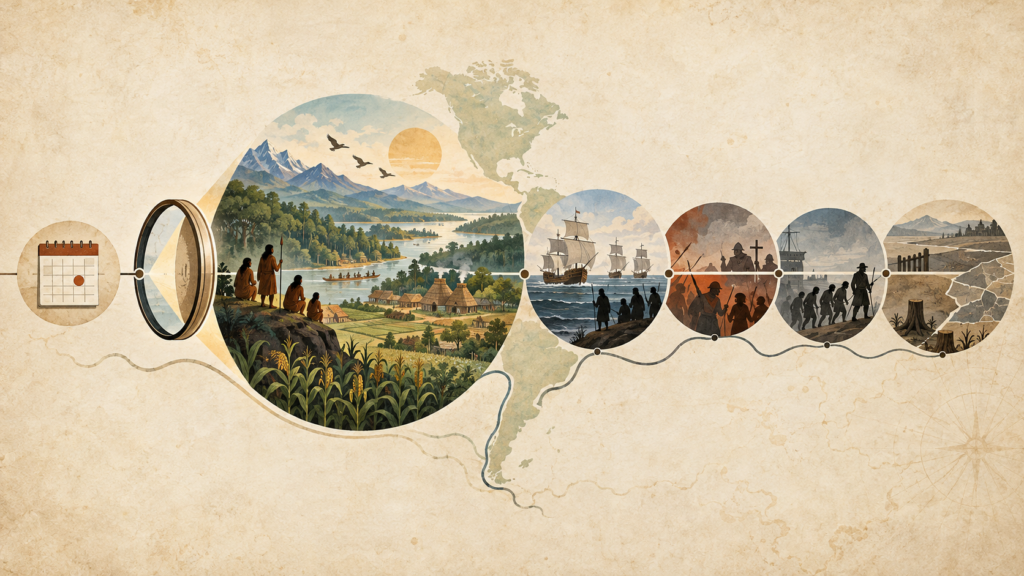
Indigenous Peoples’ Day Changes the Historical Focus
The Smithsonian’s National Museum of the American Indian explains that Indigenous peoples inhabited the Western Hemisphere long before Columbus. Its guide to Columbus Day and Indigenous Peoples’ Day describes warfare, enslavement, forced relocation, and loss of lands associated with European colonization.
Calling the voyage a discovery without that context leaves the people already living in the Americas outside the story. A fuller explanation considers both the encounter and its consequences for those communities.
The museum describes Indigenous Peoples’ Day as a second-Monday-in-October observance recognizing Indigenous peoples’ resilience and diversity. The emphasis includes continuing communities and cultures, alongside the harms of colonization. Its educational guidance encourages including contemporary Indigenous perspectives.
The two names therefore emphasize different subjects. Columbus Day centers the voyage and traditions associated with its commemoration; Indigenous Peoples’ Day centers Indigenous peoples. Sharing a calendar date does not make the observances interchangeable.
Federal recognition is also a separate question. On September 24, 2026, Senator Martin Heinrich introduced S.Res.900, supporting Indigenous Peoples’ Day and federal-holiday designation. The introduced text records referral to the Committee on Indian Affairs. It documents a proposal, rather than an enacted change to the federal calendar.
For a local event or school assignment, follow the organizer’s stated name and explain its focus accurately. North Carolina’s proclamation illustrates a state-specific designation; it does not establish a replacement of the federal observance or a particular institution’s closure.
Read the History Through More Than One Perspective
For further reading, the Library of Congress’s 1492: An Ongoing Voyage exhibition examines societies before European arrival and sustained encounters from 1492 through 1600. Its scope offers a useful way to move beyond a biography of one explorer.
When choosing educational activities, pair questions about the voyage with questions about the people already living in the Americas. Include Indigenous voices and contemporary communities, and distinguish a historical document’s viewpoint from your own explanation.
One useful reading exercise is to compare the questions each source asks. A proclamation explains the observance being declared. A museum resource asks whose experiences belong in the account. A local service notice answers what you can do that day. Read each for its specific purpose instead of expecting one source to resolve every issue.
That distinction connects the historical discussion to everyday planning. Understanding the name of an observance gives context; a dated operating notice supplies the practical details for a particular service.

Check the Service, Not Just the Building
Two dated federal notices show why closure information needs detail. In its October 5, 2026, Colorado newsroom announcement, USPS says Post Office locations will close October 12 and regular mail delivery and retail services will resume October 13.
The notice also identifies online services and self-service kiosks in select lobbies. If you need to mail something, distinguish buying postage or printing a label from receiving counter assistance. Check your location’s lobby access and the relevant delivery commitment before relying on a self-service option.
Federal Student Aid’s October 6 notice says its offices and most contact centers will close October 12, while its websites remain operational. The FPS Help Desk is an exception and remains open.
The notice also distinguishes data acceptance from processing: the FAFSA Processing System will accept data on the holiday but resume processing October 13. A website being accessible therefore does not establish that a person will answer your call or complete the next processing step that day.
Apply that distinction when asking about banks, schools, stores, and private delivery companies. For banking questions, ask separately about branch access and the transaction you want to complete. For any time-sensitive task, identify the action you need completed before relying on an announcement.
A Reliable Plan Starts With Three Questions
Before leaving home or publishing a holiday notice, answer three questions: which institution, which service, and which date? For WordPress editors, make those answers explicit in each calendar entry. Name the institution and location, identify the affected service, and specify the year. Link the institution’s own announcement beside the claim.
Preserve jurisdiction when explaining observances. Label North Carolina’s proclamation as a state designation and the presidential proclamation as the federal declaration. Keep the USPS notice’s Colorado attribution when describing its service announcement. Avoid turning a source’s title into a broader claim than its text supports; a holiday name alone cannot establish opening hours.
Preserve service scope just as carefully. In a service notice, separate staffed counters, telephone support, online access, and processing. Use the Federal Student Aid example to explain why those distinctions matter. Keep exceptions alongside the closure statement, so readers can find the available service without searching another paragraph for a qualification.
For each entry, retain the source URL, publication or update date, retrieval date, and a short supporting excerpt in your editorial record. Give a reviewer enough evidence to trace the closure claim back to its source. If the announcement leaves a particular service unclear, contact the institution before publishing that detail.
Plan the annual update before publishing. Separate stable historical explanation from year-specific declarations and service schedules; recheck the latter before reusing the page next October. A source workflow for WordPress content helps preserve the original notice, its date, and the exact service it covers. Assign a review date and an editor to confirm the next year’s notices and refresh the dated calendar image.
For everyday planning, keep the federal date and local arrangements together without treating them as identical. For understanding the holiday, keep heritage, historical evidence, and Indigenous perspectives in view. Both tasks reward the same habit: ask a precise question, then consult a source capable of answering it.
Images: AI-generated images.
Discussion
Join the discussion
Useful notes, corrections, and field experience belong here. Keep replies specific and constructive.