
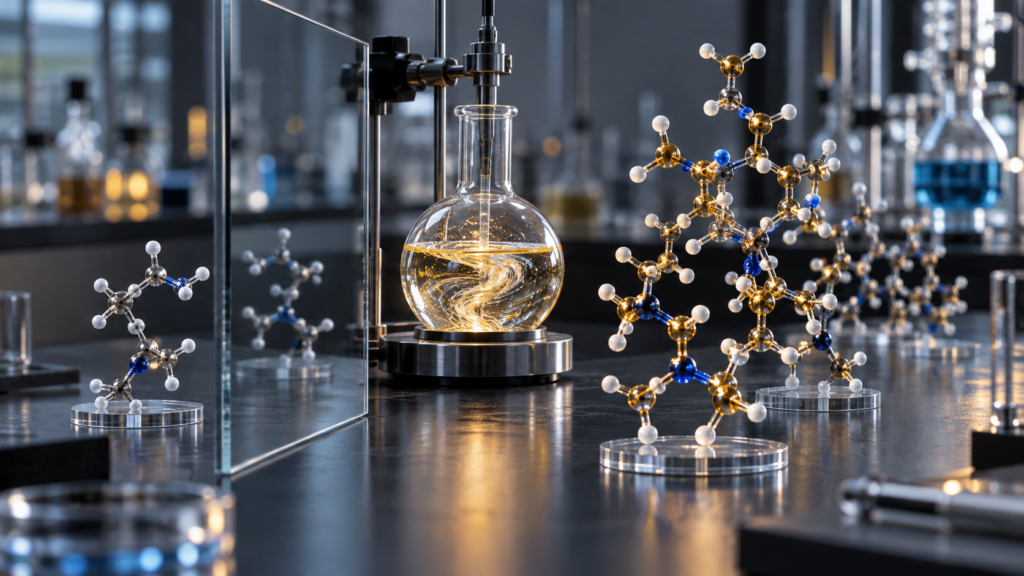
Henri B. Kagan and Kenso Soai won the 2026 Nobel Prize in Chemistry for discoveries explaining how chemical reactions can favor one molecular mirror image, the Royal Swedish Academy of Sciences announced October 7, 2026. The citation recognizes nonlinear effects and autocatalysis in asymmetric organic synthesis.
The laureates will share 12 million Swedish kronor equally. The Academy identifies Kagan with the former Université Paris-Sud in France; Université Paris-Saclay’s account of the award identifies him as its professor emeritus. Soai is professor emeritus at Tokyo University of Science in Japan. Their work connects a practical challenge in making molecules with a deeper question: how can a small molecular preference become overwhelming?
Mirror Images Can Have Different Consequences
Hold your hands palm down. They resemble each other in a mirror, but rotating one will not make it fit perfectly over the other with every feature aligned. That inability to superimpose mirror images defines chirality, illustrated by the Royal Society of Chemistry’s explanation.
Some molecules have the same kind of handedness. Their two mirror-image forms are called enantiomers, and they can behave differently when interacting with living systems. The distinction concerns their arrangement in space; simply calling two molecules mirror images does not mean they are interchangeable.
Asymmetric synthesis seeks to favor one form. A mixture enriched in one enantiomer still contains both forms; homochirality describes effectively or completely one-handed composition. Keeping those terms separate helps explain the achievement: increasing a preference and reaching an almost exclusively one-handed result are different descriptions of a reaction’s outcome.
Kagan Showed How A Small Bias Could Grow
Kagan studied the catalyst—the chemical helper in a reaction—and how its handedness relates to the product’s. The American Chemical Society’s October 7 account dates his finding to 1986: a small excess of one catalyst enantiomer can produce a larger excess of the desired product through mutual inhibition.
That is the nonlinear effect named in the award citation: the product’s handedness need not follow the catalyst’s handedness proportionally. The mechanism matters because interactions between catalyst forms, including their inhibition of one another, help explain why a reaction favors a particular product.
For chemists designing a synthesis, this makes the catalyst mixture a question to investigate. Examining how its forms interact offers more insight than assuming that the starting proportions alone dictate the result. Kagan’s contribution concerns the relationship between those starting proportions and chemical selectivity.
Soai Made The Product Reinforce Its Own Formation
Soai’s contribution adds feedback. In asymmetric autocatalysis, a chiral product helps catalyze its own production, as Soai’s laboratory explains. His reaction combines that self-catalysis with amplification of an initial imbalance between mirror-image forms.
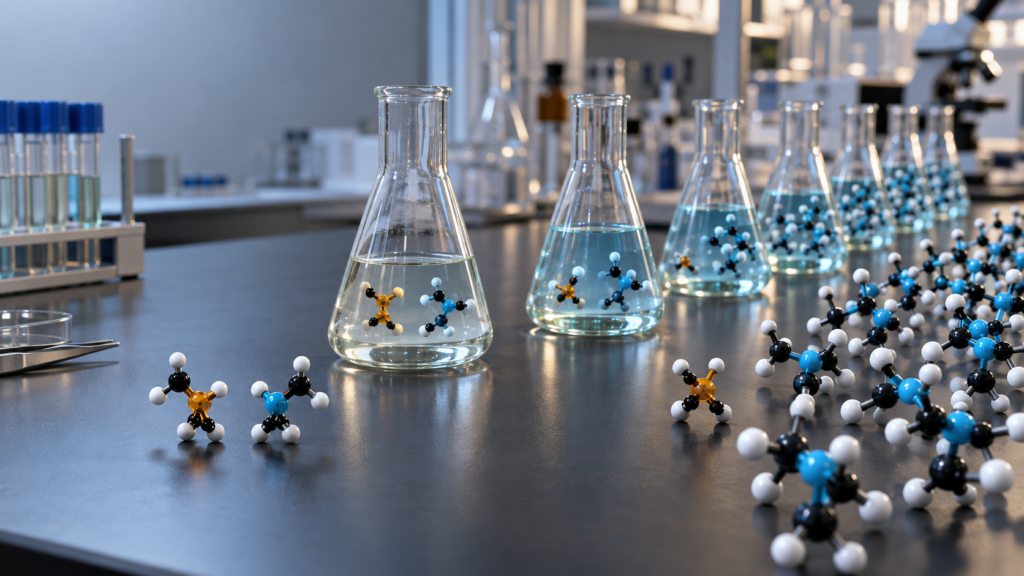
These are distinct properties. Autocatalysis means that the product participates in making more product. Amplification means that the balance between the two hands becomes more unequal. Self-catalysis alone does not establish amplification; the combination in Soai’s reaction explains how an initially small preference can become dominant.
The ACS account describes an autocatalytic, enantioselective reaction reported in 1990, followed in 1995 by a reaction whose product had greater enantiomeric excess than its catalyst. The Academy identifies the 1995 publication as a key step toward the highly selective result reported in 2003.
The 2003 primary paper reports a nearly enantiopure product, with greater than 99.5% enantiomeric excess after three cycles. That measured result shows how overwhelmingly one-handed the product became.
Making The Right Molecular Form Matters
The pharmaceutical connection follows from that selectivity. The Royal Society of Chemistry emphasizes that different molecular forms can have different biological effects, making control of handedness important in developing medicines. The Academy connects the discoveries specifically to designing reactions for pharmaceutical manufacture.
The manufacturing question is therefore concrete: how can a synthesis favor the molecular form needed for its intended biological role? These discoveries address selectivity during product formation. They connect the study of molecular asymmetry with the design of chemical processes that favor the desired arrangement.
Université Paris-Saclay’s account explains the value of studying nonlinear effects for understanding reaction mechanisms and optimizing asymmetric amplification. For a reader, this gives the prize’s technical language a practical meaning. Chemists can ask how catalyst forms interact and whether a product reinforces its own production, then use that understanding to design selective processes. Making more material and favoring the desired molecular form are separate objectives.
Life’s Preference Remains A Larger Question
The biological question is larger. In the Royal Society of Chemistry’s account of Soai’s response, he describes his reaction as a contribution to explaining homochirality while acknowledging that understanding life’s origins requires further research.
The distinction is between showing how chemistry can amplify handedness and establishing how it happened in life’s past. The experiments supply mechanisms for the first question. Their relevance to the second is a clue, rather than a complete historical reconstruction.
Read the 2026 award through those two contributions: Kagan showed how a catalytic imbalance could be amplified, and Soai combined product self-catalysis with amplification. Together, they explain how chemistry can turn a small molecular preference into a dominant outcome.
For more on this topic, see our Science coverage.
Images: AI-generated images.
Discussion
Join the discussion
Useful notes, corrections, and field experience belong here. Keep replies specific and constructive.