
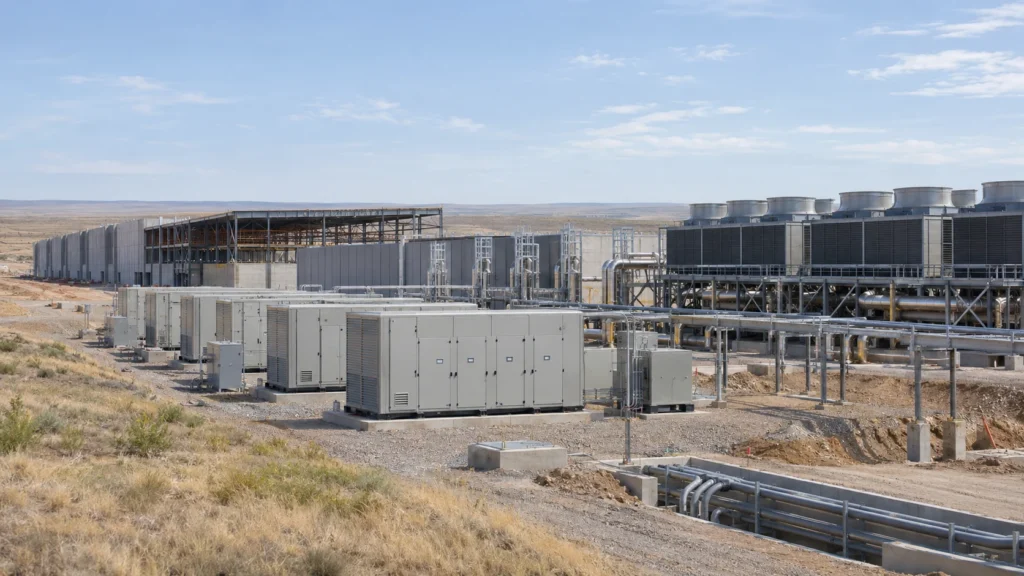
Google's $17 billion Wyoming data center plan pairs a contracted 702-megawatt fuel-cell development with carbon capture and a separate study of capture on gas turbines, the company said in its November 5 announcement.
The ownership changed, too. TechCrunch reported November 6 that Google bought Crusoe's unfinished Wyoming project. Reuters reported that Crusoe had completed its pre-development work, including site selection, government approvals and power strategy. Crusoe and Tallgrass Energy originally developed the campus together.
Wyoming Data Center Uses Two Paths to Carbon Capture
Google says American Electric Power's fuel-cell development will use U.S.-made Bloom Energy equipment to convert natural gas into electricity through an electrochemical reaction. It expects a large majority of the development's carbon emissions to be captured and stored underground at Tallgrass's nearby hub. Google says the development brings its total contracted carbon capture and storage capacity to nearly 1 gigawatt.
The campus will also draw electricity from gas generators operated by Tallgrass and Black Hills Energy. For Tallgrass's combined-cycle turbines, Google is conducting a front-end engineering and design study to evaluate adding carbon capture.
That makes the power arrangement a combination of technologies with different development commitments. Carbon capture is part of the contracted fuel-cell project; its application to the Tallgrass turbines is the subject of engineering evaluation.
Natural-gas fuel cells still produce carbon dioxide despite avoiding conventional combustion, Data Center Frontier reported November 4. The distinction between electricity generation and carbon management is central to the project's environmental ambitions.
A Long-Term Power Deal Underpins the Buildout
In its October 14 announcement, AEP outlined approximately $4 billion of investment in the 702 MW project under a 20-year agreement to sell power to Google. AEP targeted construction beginning in 2026 and full operations by the end of 2028.
AEP said it would own and control approximately 92% of Cheyenne Fuel Cell LLC, with funds advised by Basalt Infrastructure Partners holding the remaining interest. Data Center Frontier reported that an earlier $2.65 billion equipment commitment was part of the project's procurement history within the approximately $4 billion project.
The transaction leaves Crusoe involved in another Google development. Reuters reported that the company continues to develop Google's separate campus in Armstrong. For Wyoming, Google's announced partners include data center developer Related Digital, alongside the energy companies supplying and developing power for the project.
Power Costs and Water Shape the Local Stakes
Google commits to paying for all electricity it uses and covering infrastructure needs directly driven by its growth. It says air cooling will reduce pressure on local water resources and projects hundreds of millions of dollars in property taxes for Laramie County and School District 1. Google says it met more than 200 Laramie County residents before the announcement.
The expansion enters an established computing market. WyoFile reported that the Cheyenne area had 10 operating data centers and more than a dozen planned. It also cited a recent University of Wyoming poll in which 30% of residents supported allowing additional large AI data centers.
Cheyenne Mayor Patrick Collins told WyoFile that Tallgrass was preparing a one-square-mile area for the project's first phase. WyoFile also cited earlier local reporting projecting campus construction completion in 2031. That campus projection concerns a different milestone from AEP's target for full fuel-cell operations in 2028.
Google's Wyoming investment brings the physical demands of AI expansion into focus. Its power purchases and infrastructure commitments underpin the buildout, while the contracted fuel-cell capture project and turbine study represent separate stages of the emissions strategy.
For more on this topic, see our Technology coverage.
Image: AI-generated image.
Discussion
Join the discussion
Useful notes, corrections, and field experience belong here. Keep replies specific and constructive.