
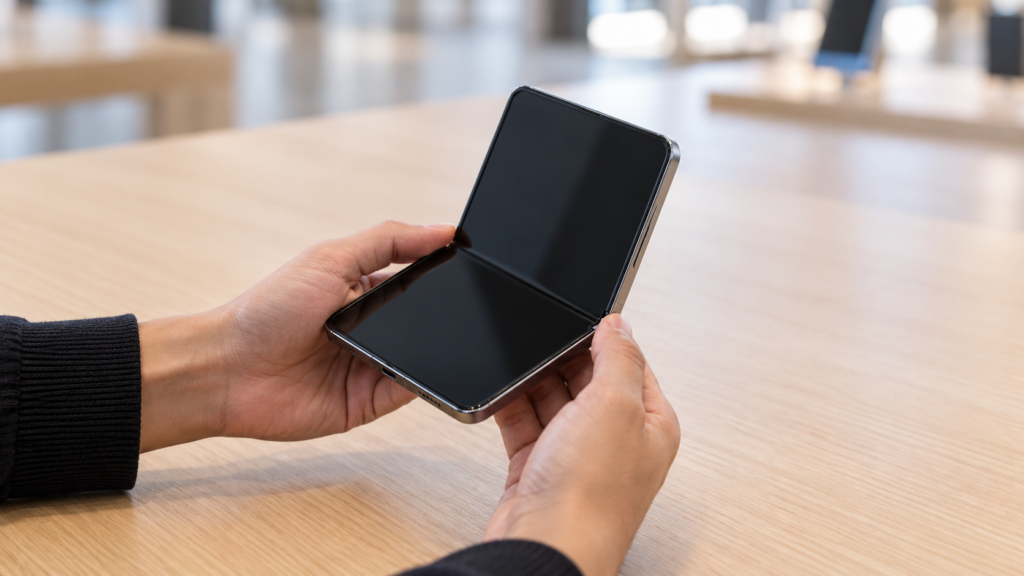
Apple's iPhone Duo went on sale at stores worldwide on October 23, 2026, according to Apple's launch report, with restricted walk-in sales and a two-handset preorder limit per customer reported by Reuters. The retail debut brings Apple's first foldable iPhone into customers' hands under purchasing conditions that matter when interpreting the opening crowds.
Reuters' launch-day coverage from Sydney, Shanghai, and Hong Kong, alongside Ben McKimm's firsthand Sydney account for Man of Many, adds independent observations to Apple's store photographs. These reports capture different parts of the same opening day.
Apple Confirms The Retail Debut
Apple's Newsroom page carries an October 22 label, but its text explicitly describes the Friday, October 23 debut. The date in the report's text establishes the event being covered here: the start of retail sales.
Apple says stores offered demonstrations and personalized shopping assistance. Its accompanying photographs show customers and employees at Apple Jing'an in Shanghai. This is company-provided coverage, useful for seeing how Apple presented the arrival of its new phone.
Sydney's Queue Answers A Local Question
In his report for Man of Many, updated October 23, Ben McKimm describes attending the George Street Apple Store opening in Sydney at 8 a.m. He found a short, orderly queue compared with what he had expected.
Reuters also reports a Sydney queue before the 8 a.m. opening. Its Shanghai reporting includes a buyer who had queued from 6 a.m.; in Hong Kong, it interviewed a preorder customer who intended to resell the handset.
These accounts supply something a crowd photograph alone cannot: a little context about when people arrived and what at least one buyer planned to do with a purchase. They remain observations of particular people and places.

Availability Changes How Lines Should Be Read
According to Reuters' October 23 launch report, syndicated by Euronext, Apple told the news agency walk-in availability would vary by country, with limited stock in several markets, including the United States and Australia. In China, France, Hong Kong, India, and Japan, Apple said units were available only to customers who had ordered online.
The preorder cap also matters: an order limit governs how many phones one customer can request, rather than revealing how many customers placed orders.
Trying a phone and securing one to take home are separate decisions. For a prospective buyer, a demonstration can serve a practical purpose: trying familiar tasks before committing. That makes the fit with someone's own routines more useful than the spectacle outside.
What Would Establish The Launch's Reception
To assess launch sales, the useful next comparison would pair completed purchases with the amount of stock offered in each market. A sold unit records a transaction; an order cap records a purchasing rule. Treating them as interchangeable would obscure the question readers actually want answered: how broadly is the phone being bought?
Queue lengths need the same care. Different purchasing arrangements can change what a line represents, and a count of people outside does not identify everyone's purchase status. McKimm's short Sydney queue therefore supplies no reliable basis for a worldwide demand verdict or a declaration that the launch disappointed.
Longer-term adoption is a separate test. It would require looking beyond opening sales to whether people keep using the new format in everyday life. Completed transactions, units offered, and behavior after purchase answer different questions; a strong assessment would keep those measures distinct. For readers comparing these reports, the key is to follow the type of evidence through the story: an eyewitness describes a scene, a company states its arrangements, and sales data would measure purchases.
Following our source and correction standards, this report identifies Apple's claims separately from independent reporting by Reuters and McKimm.
Images: AI-generated images.
Discussion
Join the discussion
Useful notes, corrections, and field experience belong here. Keep replies specific and constructive.