
Google’s new Search Console reports are small on the surface, but they change the job waiting inside WordPress. AI visibility is now URL-level editorial evidence.
On June 3, Google Search Central’s Hillel Maoz and Moshe Samet announced Search Generative AI performance reports for Search Console. For WordPress operators, the news is less about another chart and more about where the chart should end: a publishing dashboard that assigns work.
What Google Added
Google says the reports add dedicated views for Search and Discover, showing visibility within generative AI features such as AI Overviews, AI Mode, and Discover’s generative AI features. The data is still included in the overall performance report, but now gets its own view.
The initial report fields matter because they are operational. Google lists impressions, pages, countries, devices for Search results, and dates with hourly, daily, weekly, and monthly granularity. That is not a full funnel, but it is enough to identify the posts entering AI surfaces.
There is an important limit. Google said the reports were rolling out to a subset of websites for testing and feedback before wider availability. Publishers should treat the first version as a visibility layer, not as a complete attribution product.
The Old Dashboard Stops Early
Search Console is the right place to measure search visibility. It is not the right place to decide whether a WordPress post needs a new source, a better excerpt, a stronger image, or a reviewer.
Google’s AI features guidance keeps the work grounded. It says normal SEO best practices remain relevant for AI Overviews and AI Mode, with no special AI-only requirements, and that a page must be indexed and eligible to show with a snippet before it can be a supporting link.
That matches the warning in our earlier read on Google’s AI Search guide. If there is no separate trick, the advantage moves to publishing discipline: clean pages, credible sources, useful internal links, accurate metadata, and review habits that survive volume.

WordPress Holds the Action
A WordPress post is not just copy in a box. The WordPress REST API post reference exposes a structured record with status, title, content, author, excerpt, featured media, categories, tags, meta fields, dates, and update endpoints.
That is why AI visibility should not live only in an SEO spreadsheet. A URL in the new report has a corresponding publishing object. It may be published, pending review, scheduled, assigned to a category, missing a useful excerpt, or tied to an old featured image.
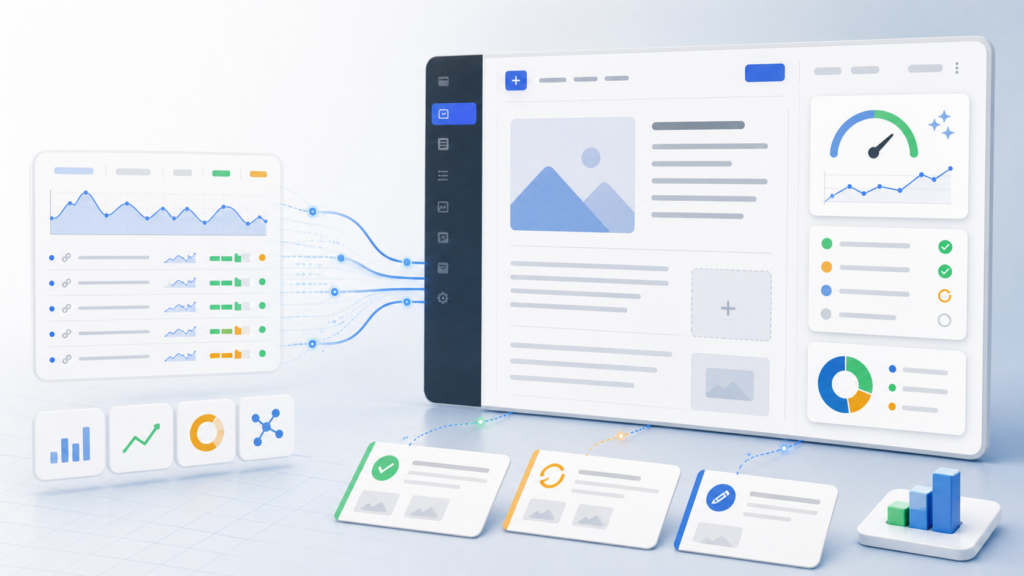
The dashboard job is to connect those two realities. Search Console says which URL appeared. WordPress says what that post is, who owns it, when it changed, which fields are weak, and whether an editor can safely touch it.
Without that mapping, the report becomes another place to look. With it, the same data becomes a queue: refresh this source, rewrite this summary, replace this image, strengthen this internal path, or leave this page alone.
Refresh Queues Need Sources
The strongest use case is not rewriting every page that appears in an AI feature. It is deciding which pages deserve editorial review because AI visibility exposed them to more demanding, exploratory searches.
Google’s SEO Starter Guide tells site owners to keep content up to date and link to relevant resources that help users and search engines understand the page. The new report gives WordPress teams a better way to prioritize that maintenance.
A practical queue should combine AI impressions, post age, source age, business importance, and topic volatility. A medical, legal, finance, or fast-moving product post deserves different treatment from an evergreen glossary page that remains accurate.
Metadata Becomes Measurable
The metadata layer is where many WordPress teams will find quick wins. Google’s snippet documentation says snippets mainly come from page content, but a meta description may be used when it gives a more accurate description, and unique page descriptions are recommended where possible.

If the AI report surfaces a URL whose excerpt is vague, duplicated, or out of date, the task is not a new article. It is a metadata cleanup tied to the actual post: title, excerpt, summary, visible intro, and supporting context.
That matters because the new report includes dimensions, not prescriptions. A country split can point to localization gaps. A device split can point to mobile presentation issues. Date granularity can show when a change became visible, without pretending it proves causation.
Discover Adds Image Work
The Discover view is the reason this cannot stay inside a keyword dashboard. Google’s Discover documentation says indexed content is automatically eligible if it meets policies, but eligibility does not guarantee appearance, and Discover traffic is less predictable than keyword-driven search.
For WordPress publishers, that makes image and preview hygiene part of the assignment. Google recommends headlines that capture the essence of the content, timely or unique insight, and compelling high-quality images, including large 16:9 images with the right preview settings.
A WordPress dashboard should therefore surface featured media, image dimensions, generic thumbnails, text-heavy images, and outdated visual context beside the AI report row. The task is not only “refresh copy.” It may be “make this page presentable in a feed.”
The Dashboard Job
A useful dashboard should not promise to optimize AI Search. It should ask better publishing questions. Which URLs appeared? What changed? Is the post still accurate? Which WordPress field is stale? Who approves the update?
The first version can be export-driven. Match Search Console URLs to WordPress posts, tag task types, attach source notes, assign reviewers, and record decisions. WP Post AI already turns client source material into reviewable WordPress drafts with SEO fields, links, generated images, and approval notes before anything lands in the CMS.
That same discipline belongs after publication. Generative AI visibility is not the end of the workflow; it is a signal that the workflow should look again, carefully and in context.
Google’s report shows where AI Search saw the site. WordPress should decide what deserves repair, proof, restraint, or a clean refresh.
Discussion
Join the discussion
Useful notes, corrections, and field experience belong here. Keep replies specific and constructive.